The New 70/30 Rule: Why Google Ads Success Today Happens Outside the Account
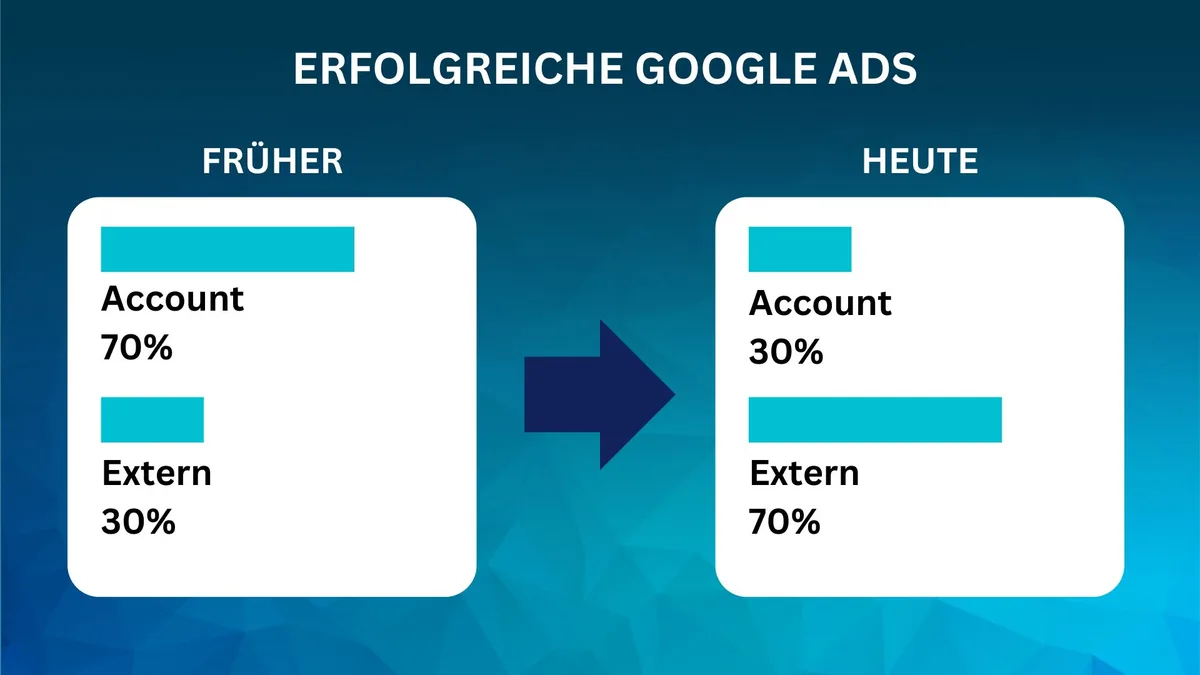
Google Ads has fundamentally changed: it used to be 70% account work, today it’s only 30%. The decisive 70% happens outside Google Ads — in the irresistible offer, the landing page, and the unit economics. Here’s how the role of a Google Ads specialist has shifted, and what that means for small and mid-sized businesses.
Google Ads has fundamentally changed. It used to be 70% account work, today it’s only 30%. The decisive 70% happens outside Google Ads, in the irresistible offer, the landing page, and the unit economics. Here’s how the role of a Google Ads specialist has shifted, and what that means for SMBs.
The fundamental shift in Google Ads management
Being a Google Ads specialist today means something completely different than it did five years ago. Back then, we spent 70% of our time inside the account on optimizations, and only 30% on everything else. Today it’s flipped: 30% inside the account, 70% outside.
This shift is driven by the development: AI is slowly taking over more and more of the work inside the account. That frees up capacity for the other areas, and the focus of manual work necessarily moves outside the account.
The complete process, from the first offer to the final purchase, decides whether you succeed. Google Ads is just one piece of it.
The 70/30 rule says: 70% of Google Ads success happens outside the account, through irresistible offers, optimized landing pages, and well-thought-out unit economics. Only 30% comes from classic account work.
The three areas that decide today whether Google Ads succeeds or fails have little to do with what we classically understand as “Google Ads management”:
1. The irresistible offer
Before any click even happens, it has to be clear: what exactly are you offering? For which audience? How do you position yourself against the competition?
I see this every day in practice: a lawyer can have the perfect Google Ads campaign. But if positioning is unclear, “lawyer for everything” instead of “specialist for employment law”, the whole effort goes nowhere.
It’s the same for a contractor: premium services need a different approach than standard work. The local specialization has to be visible in the offer itself.
2. Landing page optimization
The best Google Ads campaign is worthless if the landing page doesn’t convince. This isn’t about pretty design, it’s about trust and conversion.
For a law firm, that means: show authority, build trust, move the visitor to immediate contact. Prospects need to understand within seconds that they’re in the right place.
Contractors need to show projects, communicate availability, and create trust. Anyone who doesn’t show their recent work loses potential customers to the competition.
3. Understanding unit economics
Maybe the most important point: what does a customer actually cost? What do they bring you long term? Without these numbers, every Google Ads optimization is guesswork.
A lawyer needs to know: what does a client cost in acquisition versus what do they bring over the full client relationship? A one-time traffic accident case calculates differently than a long-term corporate law mandate.
For contractors it’s the same: understand project profitability, calculate lifetime value, derive realistic CPCs. Without that foundation, no Google Ads strategy is sustainable.
The most common cause of Google Ads failure isn’t bad keywords or wrong bid strategies. It’s unclear offers, weak landing pages, and missing unit economics. If you don’t have these three areas under control, you can have the best Google Ads account in the world — it will still fail.
What’s left: the 30% of classic account work
Classic account work hasn’t become unimportant, but it’s no longer the main focus. AI is taking over more and more optimization tasks, although handing everything to AI is still very risky at this point.
The 30% account work that remains critical:
- Defining goals and KPIs correctly
- Setting up conversion tracking cleanly
- Building campaign structure strategically
- Optimizing targeting precisely
- Testing creatives systematically
- Managing bids and budget intelligently
The shift is that these tasks have become increasingly strategic. Instead of manually adjusting bids, the question is the right configuration of Smart Bidding. Instead of monitoring keywords individually, the question is the right balance between automation and control.
These tasks still require expertise. But they only deliver their impact when the 70% is in place.
Practical examples: what the 70% looks like in real life
Law firm: family law specialist
Offer
Focus: divorce (most lucrative area)
Audience: working parents going through separation
Positioning: fast, discreet solutions with child welfare at the center
Landing page
Trust: certifications, memberships, years of experience prominently shown
Authority: successful cases (anonymized), professional publications
Contact: direct call button, online appointment booking, 24-hour callback guarantee
Unit economics
Average client value: €3,500
Acceptable CPC: up to €45 (at 15% conversion rate)
Lifetime value: up to €8,000 with follow-up mandates
Contractor: premium bathroom renovations
Offer
Focus: complete bathroom renovations in the premium segment
Audience: homeowners, 45+, higher income
Positioning: 20 years of experience, quality craftsmanship, 5-year warranty
Landing page
Projects: before/after images of the last 10 renovations
Availability: current capacity, realistic timelines
Trust: customer references, quality certifications, fixed-price guarantee
Unit economics
Average project: €25,000
Acceptable CPC: up to €80 (at 8% conversion rate to site visit)
Follow-up projects: 40% of customers book again within 3 years
These examples show: the 70% requires just as much strategic thinking as the Google Ads campaigns themselves. The difference is that this is where the foundation for long-term success gets laid.
What this means for SMBs: partner instead of button-pusher
This development has direct consequences for choosing a Google Ads provider. SMBs should no longer look only for account management skills, but for partners who understand the full context.
What SMBs should look for
A good Google Ads partner today can tell you when SEO is more important than Google Ads. Or when website optimization should take priority. They understand unit economics and can advise on offer development.
That doesn’t mean they have to do all of it themselves. But they should know when which experts to bring in, and how the different areas play together.
The end of pure specialists
Pure Google Ads specialists who only optimize keywords and bid strategies will have an increasingly hard time. The future belongs to “T-shaped” experts: deep expertise in Google Ads, but broad understanding of marketing, conversion optimization, and business strategy.
If your current Google Ads provider has never asked about your business model, your unit economics, or your positioning, they’re probably still operating under the old 70/30 model. Time for a conversation about new priorities.
Recommended approach:
-
Sharpen your offer: define clearly which audience you’re targeting, which specific problems you solve, and how you differ from competitors.
-
Calculate your unit economics: figure out your real customer acquisition cost and lifetime value. These numbers are the basis for all Google Ads decisions.
-
Run a landing page audit: test with fresh eyes whether it’s immediately clear what you offer, whether trust gets established, and whether the path to contact works.
-
Evaluate your Google Ads partner: check whether they understand the 70% or only optimize keywords and bids.
-
Think holistically: Google Ads is one piece. Make sure all areas — from offer to customer service — work together.
Bottom line: Google Ads is just the start
The new 70/30 rule doesn’t make Google Ads less important. It just shows that successful online marketing has to be thought about much more broadly.
For SMBs that means: invest not just in better campaigns, but in better offers, better landing pages, and better understanding of your numbers. If you have the 70% under control, Google Ads will work too.
Treat Google Ads not as an isolated channel, but as part of a deliberate overall strategy. The future belongs to those who understand the full funnel.
Need a fresh pair of eyes on your Google Ads account?

Benjamin Häntzschel
Google Ads, AI & Conversion Optimization